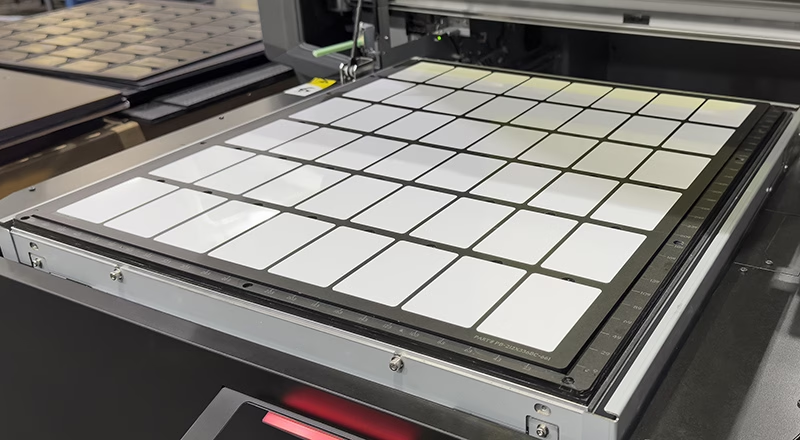
When most companies evaluate a UV flatbed printer, they focus on print quality, speed, ink configuration, or printhead technology. One of the biggest factors affecting long-term profitability and throughput often gets overlooked: fixturing.
Whether you print promotional products, industrial components, cosmetic packaging, drinkware, electronics, medical devices, or specialty items, your fixturing strategy directly impacts UV flatbed productivity, job setup time, labor costs, and overall equipment effectiveness (OEE). A well-designed fixture reduces setup time, improves registration accuracy, minimizes operator error, and increases throughput. Poor fixturing creates bottlenecks that limit production capacity, raise labor costs, and can impact scrap rates.
In many operations, the difference between a profitable UV printing business and an inefficient one comes down to fixturing.
What Is UV Printing Fixturing?
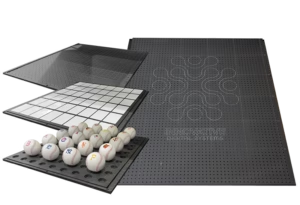 Fixturing is the system used to consistently position products on a UV flatbed printer so every item prints in the exact same location, every time.
Common fixturing methods include:
- Peg boards
- Product nests
- Vacuum fixtures
- Custom jigs
- Magnetic fixtures
- Modular fixture systems
- Rotary attachments
- Registration systems
- Pin sets
The goal is simple: achieve repeatable, accurate product placement that supports fast loading and consistent print registration across production runs.
Why Fixturing Matters More Than Most Companies Realize
Production output is often limited by loading and unloading rather than print speed. Two shops running identical printers can achieve dramatically different daily output depending on their fixturing approach. The goal is to keep your machine in motion as much as possible. If it is sitting still, you are losing profitability.
A properly designed fixture reduces operator guesswork, shortens changeover time, and supports higher output. This directly improves:
- Throughput and jobs per shift
- Labor cost per part
- Print registration accuracy
- Product changeover speed
- Consistent control of printable area
- Operator efficiency
- Production consistency
- Scalability for future automation
The printer may be the engine of production, but fixturing determines how efficiently that engine operates.
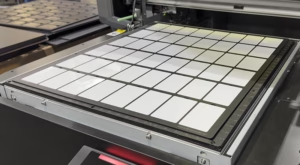
Split Peg Boards vs. Continuous Peg Boards
One of the most important fixturing decisions involves choosing between split and continuous peg board designs.
Continuous Peg Boards
A continuous peg board spans the entire print area.
Advantages:
- Maximum fixture placement flexibility
- Ideal for oversized products
- Unlimited positioning options
- Simplified fixture design
- Better support for unique applications
Potential drawbacks:
- Longer setup times between jobs
- Larger fixture changes may require removing the entire setup
- Can be large and cumbersome and/or heavy when fully loaded
Continuous systems are often preferred for companies running larger products or highly varied production.
Split Peg Boards
A split peg board divides the print area into removable sections.
Advantages:
- Faster fixture changes
- Reduced downtime between jobs
- Ability to swap fixture zones independently
- Better support for multiple SKUs
- Improved production flexibility
- Less cumbersome and/or lighter for operators to use
Potential drawbacks:
- Slightly reduced flexibility for oversized products
- More fixture organization and management
- More pieces to change cycle to cycle
Many high-production UV printing facilities prefer split systems because they allow operators to change jobs quickly without disrupting the entire production table.
Vacuum Tables vs. Peg Board Fixturing
Another common question is whether to use vacuum fixturing, peg board fixturing, or a combination of both.
Vacuum Tables
Vacuum tables use suction to hold products in place.
Advantages:
- Fast setup
- Excellent for flat materials
- Minimal fixture requirements
- Ideal for signage and sheet goods
Limitations:
- Less effective on irregular objects as well as small objects
- Difficult to secure highly dimensional products
- Limited support for repeatable multi-part positioning
Peg Board Systems
Peg board systems use physical registration points to locate fixtures.
Advantages:
- Superior repeatability
- Better support for custom fixtures
- Ideal for promotional products and industrial components
- Easier multi-part production workflows
Many manufacturers use vacuum hold-down combined with peg board registration systems to maximize both speed and repeatability.
Designing Fixtures for Maximum Throughput
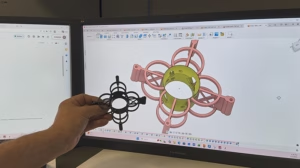 The most productive fixtures share several key characteristics.
High Part Density
The more products printed per cycle, the more productive the machine becomes.
Benefits include:
- Higher throughput
- Lower labor cost per part
- Better machine utilization
- Increased profitability
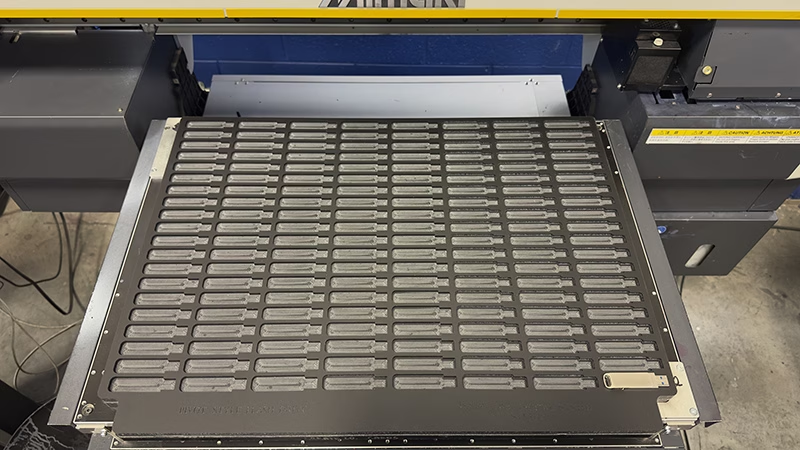
Fast, Intuitive Loading
Operators should be able to load products quickly without extensive alignment or measurement.
Complicated fixtures often reduce productivity despite providing excellent positioning.
Repeatable Registration
Every product should locate automatically and consistently. The best fixtures eliminate operator interpretation entirely.
Durability
Fixtures should withstand thousands of production cycles without losing positioning accuracy.
Registration Accuracy and Tolerance Control
One of the most overlooked aspects of fixturing is registration control.
Customers often focus on printer resolution while ignoring the fact that registration errors are frequently caused by inconsistent product placement.
Proper fixture design helps maintain:
- Print-to-part alignment
- Repeatability across production runs
- Multi-layer print registration
- Variable data placement accuracy
- Tight manufacturing tolerances
This becomes especially important when printing:
- Barcodes
- QR codes
- Industrial markings
- Electronics
- Medical devices
- Multi-pass graphics
The more precise the fixture, the more consistent the output.
Choosing the Right Fixture Materials
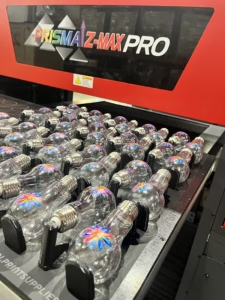 Fixture material selection affects durability, cost, and long-term performance.
Common fixture materials include:
HDPE
- Durable
- Easy to machine
- Cost-effective
- Popular for production fixtures
Delrin
- Excellent dimensional stability
- High precision
- Long service life
Acrylic
- Inexpensive
- Easy to prototype
- Common for low-volume applications
Aluminum
- Extremely durable
- Ideal for industrial environments
- Suitable for high-volume production
The right material depends on production volume, product weight, and required accuracy.
Modular Fixturing Creates Long-Term Value
One of the most common mistakes companies make is designing fixtures around a single job.
Markets change.
Customers introduce new products.
Production requirements evolve.
Modular fixturing systems allow businesses to adapt without rebuilding workflows from scratch.
Benefits include:
- Faster product onboarding
- Reduced fixture development costs
- Greater operational flexibility
- Easier scalability
- Improved equipment utilization
This approach is especially valuable for promotional product decorators, contract manufacturers, and industrial printers serving multiple industries.
Industry-Specific Fixturing Strategies
Different industries require different fixturing approaches.
Promotional Products
Focus on:
- High part density
- Fast product changeovers
- Multi-SKU production
- Personalized printing workflows
Industrial Manufacturing
Focus on:
- Tight registration tolerances
- Barcode and QR code accuracy
- Repeatability
- High-volume production
Electronics
Focus on:
- Precision alignment
- Component protection
- Small-part positioning
Medical Devices
Focus on:
- Traceability
- Repeatability
- Validation and quality control
Injection Molded Components
Focus on:
- Complex geometries
- Consistent placement
- High-volume manufacturing efficiency
The best fixture designs are application-specific rather than one-size-fits-all.
Fixturing and Automation Readiness
As UV printing operations scale, well-designed fixturing becomes the foundation for automation.
Future automation initiatives often include:
- Camera registration systems
- Robotic loading
- Conveyor workflows
- Pick-and-place systems
- Lights-out manufacturing
Poor fixturing creates alignment issues, registration errors, and increased scrap rates.
Good fixturing creates a pathway to automation and long-term production growth.
The Most Overlooked ROI Factor in UV Printing
Companies frequently compare printers based on speed, resolution, or printhead technology while underestimating how fixturing affects profitability.
A strong fixturing strategy can:
- Increase production throughput
- Reduce setup time
- Lower labor costs
- Improve registration accuracy
- Reduce waste and scrap
- Accelerate changeovers
- Improve overall equipment effectiveness (OEE)
The result is greater production value from the same printer investment.
Final Thoughts
The most successful UV printing operations don’t simply invest in high-performance equipment. They invest in the workflows, tooling, registration systems, and fixturing strategies that allow those printers to operate at maximum efficiency.
Whether you’re producing promotional products, industrial components, consumer goods, cosmetics, electronics, or medical devices, the right fixturing strategy can dramatically improve throughput, consistency, and profitability.
In UV printing, you should expect the most out of your machine.
Great fixturing is the only way to maximize your machine’s production value.
Engineering Fixture Systems at IDS
At IDS, we work closely with manufacturers to develop robust, custom solutions for their unique fixturing needs. In order to engineer maximum production value and rapidly address the real-time needs of our customers, all of our custom pegboards and fixturing systems are developed fully in-house at our facility in North Carolina.