UV Printing Frequently Asked Questions
UV Printing
UV printing is a digital printing process that uses ultraviolet (UV) light to instantly cure special inks as they’re printed. Instead of drying, the ink hardens on contact, creating sharp, durable, and vibrant prints. Because it cures instantly, UV printing works on almost any surface — plastics, glass, metal, wood, acrylic, and others — and supports both flat and curved items.
This technology is perfect for direct-to-object printing, making it ideal for short runs, customization, and fast production in signage, packaging, and promotional products.
Learn more: What Is UV Printing and How Does It Work?
High-gap (High Throw) UV printing allows a UV printer to jet and cure ink from farther away than a traditional UV printer allows — ideal for curved or uneven surfaces like mugs, bottles, and industrial parts.
Traditional printers need a tight gap between the print head and surface. High-gap printers, however, use advanced print heads, UV inks, and powerful curing systems to maintain precision from a greater distance. The result: clean, durable prints on objects standard printers can’t handle.
Learn more: High Gap (High Throw) UV Digital Printing: Revolutionizing Printing with Innovative Digital Systems
An inkjet printer creates images by spraying tiny droplets of ink onto a surface with extreme precision. It prints directly from digital files — no plates or screens required — making it fast, flexible, and easy to customize.
In industrial UV printing, inkjet printers use UV-curable inks that harden instantly under UV light, allowing direct printing on glass, metal, wood, and more.
Advanced Ricoh print heads (used in IDS printers) ensure accurate color, fine detail, and consistent results, even on curved surfaces.
A printhead is the part of an inkjet printer that sprays tiny droplets of ink onto a surface to form an image. It controls droplet size, placement, and speed — determining how sharp and consistent the print looks.
In UV printers, the printhead works with UV-LED curing systems that harden ink instantly. IDS printers use Ricoh Gen6 printheads, known for long-distance jetting, fine detail, and high precision.
A print bed is the platform that holds your item steady during printing. There are three main styles of print bed: flatbed, rotary or cylindrical, and conveyor.
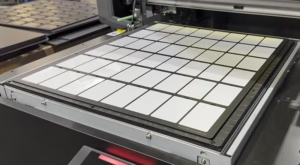
Flatbed UV printers use a vacuum table for flat materials like acrylic or metal.
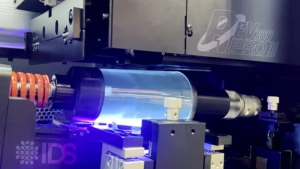
Rotary printers (also known as cylindrical printers) use a cylindrical fixture to rotate curved items, while conveyor-style printers use a moving belt for continuous, high-volume production.
Each setup keeps products stable and aligned for sharp, consistent results across different shapes and materials.
UV printing is ideal for promotional items because it delivers high-resolution graphics, consistent color, and scratch-resistant finishes. The instant curing process also reduces production time, making it efficient for short runs, personalization, or just-in-time manufacturing.
Yes. When combined with rotary or high-gap printing techniques, UV printing can be applied to cylindrical or slightly irregular objects (like drinkware). Specialized fixtures and rotary attachments help maintain alignment and curing uniformity.
Rotary Printing
Rotary printing involves rotating the part during printing so that artwork wraps around the circumference without distortion. It’s commonly used for bottles, jars, and cylindrical promotional products to achieve 360° designs.
Rotary printing works best with round or slightly tapered objects made of plastic, metal, or glass. Examples include water bottles, jars, tumblers, and tubes. Proper fixturing ensures the item rotates evenly for precise graphics.
Pad and screen printing traditionally offer limited coverage and may require multiple print passes. Rotary UV printing provides full wrap-around designs in a single pass, greater color fidelity, and better resolution without the need for separate plates or extended drying times.
Bottle Printing
To print on bottles, use a rotary UV printer with a cylindrical fixture that turns the bottle as it prints. After loading your design, mount and align the bottle, then print with UV-curable inks that harden instantly.
This process delivers seamless, high-resolution prints on glass, plastic, or metal bottles — waterproof, durable, and ready for production.
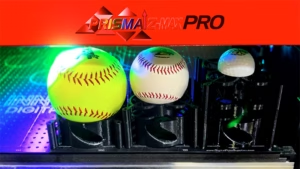
IDS printers like the RevPro 360 and Prisma ZMax PRO are built for precise, high-speed bottle printing.
Yes. Our rotary and UV-printing capabilities allow full-wrap, 360° designs on a wide range of bottles, tumblers, and drinkware made of metal, plastic, or glass. We can handle small runs or large production quantities.
Stackable tooling refers to modular fixtures that enable rapid changeovers between different bottle sizes or shapes. It enhances efficiency by reducing downtime when switching between product runs, making it ideal for promotional products with varying dimensions.
We perform surface pretreatment (such as flame treatment, corona discharge, or primers) to promote ink bonding. Our UV inks are formulated for excellent adhesion on powder-coated metals, stainless steel, and other challenging substrates.
Drinkware Printing
We can print on various drinkware products, including mugs, tumblers, water bottles, wine glasses, and travel cups. Our rotary and UV-printing processes accommodate many shapes and materials, including glass, ceramic, stainless steel, and plastic.
Our UV-cured inks are scratch-resistant and dishwasher-safe when properly adhered. With appropriate pretreatment and curing, printed drinkware retains its vibrant colors and crisp graphics even after repeated washing.
Mug Printing
The easiest way to print on mugs is with a rotary UV printer, which holds and spins the mug while printing. Just load your design, mount the mug, adjust height and alignment, and print with UV-curable inks that cure instantly under UV light. The result? Full-color, wraparound graphics that are vivid, durable, and scratch-resistant.
IDS printers like the RevPro 360 and Prisma Z-Max PRO make this process simple and precise.
To put a picture on a mug, use a UV rotary printer for direct-to-object printing.
Import your image, mount the mug on the rotary fixture, set the print height, and print with UV inks that cure instantly under UV light. You’ll get bright, photo-quality prints that are durable, waterproof, and scratch-resistant — no decals or heat transfers needed.
IDS printers like the RevHDL, RevPro 360, and Prisma Z-Max PRO make printing photos or logos on mugs fast and easy.
High-Gap Printing (High-Throw Printing)
High-gap (High Throw) UV printing allows a UV printer to jet and cure ink from farther away than a traditional UV printer allows — ideal for curved or uneven surfaces like mugs, bottles, and industrial parts.
Traditional printers need a tight gap between the print head and surface. High-gap printers, however, use advanced print heads, UV inks, and powerful curing systems to maintain precision from a greater distance. The result: clean, durable prints on objects standard printers can’t handle.
Learn more: High Gap (High Throw) UV Digital Printing: Revolutionizing Printing with Innovative Digital Systems
It’s ideal for items with embossed logos, raised patterns, or uneven geometry where standard printing would be impossible or risky. High-gap printing ensures consistent ink deposition without compromising print head safety.
Products like phone cases with raised edges, backpacks or bags with zippers, and small home goods with embossed textures can be printed clearly thanks to the wider nozzle clearance.
Industrial Product Decoration
We serve electronics, automotive, consumer goods, cosmetics, and promotional-product companies. Our high-speed digital printing solutions add logos, barcodes, or regulatory information directly on finished products or components.
Yes. Our industrial printers are designed for high throughput while maintaining consistency. We offer in-line integration with automated feeding systems, robotics, and quality-control cameras for efficient mass production.
Absolutely. Our digital workflow accommodates variable data, sequential serial numbers, and unique barcodes without slowing production. It’s especially useful for traceability and personalized promotional items.
Direct-to-Object Printing
DTO printing uses digital print heads to apply ink directly to 3D items without labeling or transfers. It delivers high-resolution imagery on complex shapes and eliminates the need for labels or additional adhesive materials.
Using UV inkjet technology, DTO can be used to decorate flat, curved, or textured items — from bottles and tumblers to metal panels or industrial parts. The UV ink cures instantly, so prints are vivid, durable, and ready for handling. DTO printing saves time, reduces steps, and gives products a polished, high-end look.
Learn more: How UV Inkjet Printing Works for Direct-to-Object Applications
Traditional methods like pad or screen printing require plates or screens, restricting design changes and colors. DTO printing enables quick setup, full-color graphics, and on-demand customization, improving efficiency and design flexibility.
Yes. Our DTO printers accept variable artwork files, so each object can have unique images, names, or codes without downtime. This is perfect for personalized promotional items, event merchandise, or limited-edition runs.
UV DTF printing stands for Ultraviolet Direct-to-Film and uses UV-curable inks to print vibrant, durable graphics onto a special film. The design is then transferred to hard surfaces using adhesive and pressure.
Unlike fabric DTF, UV DTF is made for glass, metal, wood, acrylic, and plastics. It’s perfect for irregular objects that are hard to print on directly — like bottles or textured products.
The cured prints are waterproof, scratch-resistant, and long-lasting. UV DTF is often used alongside direct-to-object printing for extra flexibility.
Adhesion & Pretreatment
Pretreatment cleans, activates, or primes the surface to enhance ink adhesion. Without it, inks may peel, fade, or chip prematurely. Common methods include flame treatment, plasma or corona discharge, and adhesion-promoting primers.
We analyze the substrate’s material, surface energy, and finish. For example, flame treatment may be used on polypropylene, while plasma treatment or primers are better for metals and glass. We always perform adhesion tests to confirm proper bonding.
Yes. IDS conducts adhesion testing (like tape tests) to validate that our printing meets durability requirements. We also advise on recommended care instructions to preserve the print’s integrity.
Pricing & ROI
The cost of a UV printer depends on print size, automation level, production speed, and application requirements. Industrial UV printers range from entry-level systems to fully automated production platforms designed for high-volume manufacturing and promotional product decoration.
To get an accurate quote on a price for your unique specifications, connect with us today
ROI depends on production volume, labor savings, reduced outsourcing costs, increased throughput, and expanded product offerings. Many companies see ROI through faster turnaround times, higher production capacity, improved margins, and the ability to bring decoration in-house.
IDS machines are designed as robust solutions to the industry’s biggest problems. Our tech and customer support teams work with you (even after purchase) to ensure you achieve maximum ROI.
UV printing eliminates screens, plates, transfers, and many setup costs associated with traditional decoration methods. It also reduces labor requirements, minimizes waste, and enables short-run production without expensive tooling.
Yes. UV printing allows decorators and manufacturers to offer premium decoration, personalization, variable artwork, and specialty effects that often command higher margins than traditional decoration methods.
Most industrial printing equipment manufacturers offer financing and leasing options to help businesses acquire production equipment while preserving cash flow and working capital.
Support & Compliance
IDS provides installation, operator training, workflow setup assistance, and ongoing technical support to help you maximize productivity and print quality.
Support may include phone support, remote diagnostics, software assistance, preventative maintenance programs, on-site service, and replacement parts programs.
Yes. Routine maintenance typically includes printhead cleaning, nozzle checks, calibration procedures, and periodic inspection of mechanical components to ensure consistent performance.
IDS offers extended warranties on our machinery. For more details connect with us today.
Industrial UV printers are designed with safety features such as enclosed curing systems, emergency stop functions, and operator protection mechanisms to comply with applicable safety regulations.
Many UV printing systems can be configured with inks and workflows suitable for food and beverage packaging applications. Compliance requirements vary depending on region, application, and end-use specifications.
Quality & Color Management
Modern UV printers are capable of producing highly accurate colors using advanced color management systems, ICC profiles, and calibrated workflows.
Our UV printing systems can precisely match Pantone colors through color profiling and ink optimization processes, helping brands maintain consistent visual identity throughout the production run.
Industrial UV printers can produce extremely fine detail, small text, barcodes, gradients, and photographic-quality graphics suitable for promotional products, packaging, and industrial applications.
Color consistency is maintained through calibration procedures, controlled workflows, color management software, environmental controls, and routine equipment maintenance.
Yes. UV printing systems can build layers of ink and varnish to create raised textures, tactile effects, spot embellishments, and premium packaging finishes.
When properly cured and adhered, UV printed graphics offer excellent resistance to scratching, fading, moisture, chemicals, and everyday wear.
Materials & Compatibility
UV printers can decorate a wide range of materials including glass, plastic, acrylic, metal, aluminum, stainless steel, wood, ceramic, coated substrates, and many composite materials.
Yes. Many UV printing systems can print directly onto powder-coated products when proper adhesion testing and pretreatment procedures are followed.
Yes. UV printing is widely used for glass bottle decoration, drinkware printing, cosmetic packaging, barware, and specialty glass products.
Yes. UV printing is commonly used to decorate tumblers, mugs, water bottles, travel cups, and insulated drinkware.
Advanced UV printers with high-gap printing capabilities and specialized fixturing can print on sports balls, curved products, and dimensional objects that are difficult to decorate using traditional methods.
Yes. Some plastics, glass products, and specialty substrates may require flame treatment, plasma treatment, corona treatment, primers, or adhesion promoters to optimize print durability due to their low surface energy.
Maintenance & Troubleshooting
Most industrial UV printers require only routine preventative maintenance, including printhead cleaning, nozzle checks, and periodic calibration.
Cleaning schedules vary by machine and production volume, but we recommend daily maintenance procedures to maximize print quality and printhead longevity.
Common causes include contamination, improper surface preparation, insufficient curing, incorrect ink selection, or inadequate pretreatment.
Adhesion can often be improved through flame treatment, plasma treatment, corona treatment, adhesion promoters, optimized curing settings, and proper substrate cleaning.
Printhead lifespan varies based on usage, maintenance, environment, and operating conditions. Proper care can significantly extend printhead life and maximize production uptime.
Regular maintenance, proper environmental controls, recommended ink handling procedures, and routine nozzle checks help minimize clogging and maintain consistent print quality.
Design & File Preparation
Vector formats such as PDF, AI, EPS, and SVG are preferred for logos and line art, while high-resolution raster files are commonly used for photographic images.
Yes. Modern UV printing systems can accurately reproduce small text, fine lines, intricate graphics, barcodes, QR codes, and detailed artwork.
Yes. Variable artwork printing allows multiple designs, names, barcodes, serial numbers, and graphics to be printed within the same production cycle.
Variable artwork printing increases flexibility, reduces setup time, enables personalization, and supports short-run production without sacrificing productivity.
Yes. IDS’s custom fixtures allow you to print multiple sizes and shapes in one production run, with zero changeover – just load up the machine and print.
Artwork should be designed to account for product dimensions, taper, printable area, and wrap requirements to ensure accurate registration and optimal appearance.
Sustainability & Environmental Impact
UV printing is generally considered environmentally responsible because UV inks cure instantly, generate minimal waste, and often contain lower VOC emissions than traditional printing methods.
Modern UV LED printing systems produce significantly fewer emissions than many traditional decoration technologies and often eliminate the need for solvent-based drying processes.
Yes. Digital workflows eliminate screens, plates, and many consumables while allowing on-demand production that reduces excess inventory and waste.
UV LED curing systems consume significantly less energy than conventional curing technologies and provide instant on/off functionality that further reduces power consumption.
Yes. UV printing can contribute to sustainability goals through reduced waste, lower energy consumption, streamlined production processes, and decreased reliance on outsourced decoration workflows.
UV printing is a digital printing process that uses ultraviolet (UV) light to instantly cure special inks as they’re printed. Instead of drying, the ink hardens on contact, creating sharp, durable, and vibrant prints. Because it cures instantly, UV printing works on almost any surface — plastics, glass, metal, wood, acrylic, and others — and supports both flat and curved items.
This technology is perfect for direct-to-object printing, making it ideal for short runs, customization, and fast production in signage, packaging, and promotional products.
👉 Learn more: What Is UV Printing and How Does It Work?
An inkjet printer creates images by spraying tiny droplets of ink onto a surface with extreme precision. It prints directly from digital files — no plates or screens required — making it fast, flexible, and easy to customize.
In industrial UV printing, inkjet printers use UV-curable inks that harden instantly under UV light, allowing direct printing on glass, metal, wood, and more.
Advanced Ricoh print heads (used in IDS printers) ensure accurate color, fine detail, and consistent results, even on curved surfaces.
High-gap (High Throw) UV printing allows a UV printer to jet and cure ink from farther away than a traditional UV printer allows — ideal for curved or uneven surfaces like mugs, bottles, and industrial parts.
Traditional printers need a tight gap between the print head and surface. High-gap printers, however, use advanced print heads, UV inks, and powerful curing systems to maintain precision from a greater distance. The result: clean, durable prints on objects standard printers can’t handle.
👉 Learn more: High Gap (High Throw) UV Digital Printing: Revolutionizing Printing with Innovative Digital Systems
A UV printer is used to print full-color, high-resolution graphics directly onto all kinds of materials — plastic, glass, wood, metal, acrylic, and more. It’s ideal for direct-to-object printing on flat and curved items like mugs, tumblers, bottles, and packaging. UV inks cure instantly under UV light, creating tough, scratch-resistant prints that are ready right away.
You’ll find UV printers in industries from promotional products to industrial manufacturing for fast, customized decoration.
Direct-to-object printing means printing images or text right onto a product’s surface instead of using labels or transfers.
Using UV inkjet technology, it can decorate flat, curved, or textured items — from bottles and tumblers to metal panels or industrial parts. The UV ink cures instantly, so prints are vivid, durable, and ready for handling. DTO printing saves time, reduces steps, and gives products a polished, high-end look.
👉 Learn more: How UV Inkjet Printing Works for Direct-to-Object Applications
UV DTF printing stands for Ultraviolet Direct-to-Film and uses UV-curable inks to print vibrant, durable graphics onto a special film. The design is then transferred to hard surfaces using adhesive and pressure.
Unlike fabric DTF, UV DTF is made for glass, metal, wood, acrylic, and plastics. It’s perfect for irregular objects that are hard to print on directly — like bottles or textured products.
The cured prints are waterproof, scratch-resistant, and long-lasting. UV DTF is often used alongside direct-to-object printing for extra flexibility.
A UV printer can print on almost anything — plastic, glass, metal, wood, leather, acrylic, or ceramic. It’s used for everything from drinkware and phone cases to signs, packaging, and industrial parts.
With features like high-gap printing and rotary fixtures, UV printers can even handle curved or textured objects. That versatility makes UV printing perfect for customization, short runs, and on-demand decoration.
The easiest way to print on mugs is with a rotary UV printer, which holds and spins the mug while printing. Just load your design, mount the mug, adjust height and alignment, and print with UV-curable inks that cure instantly under UV light. The result? Full-color, wraparound graphics that are vivid, durable, and scratch-resistant.
IDS printers like the RevPro 360 and Prisma ZMax PRO make this process simple and precise.
To print on bottles, use a rotary UV printer with a cylindrical fixture that turns the bottle as it prints. After loading your design, mount and align the bottle, then print with UV-curable inks that harden instantly.
This process delivers seamless, high-resolution prints on glass, plastic, or metal bottles — waterproof, durable, and ready for production.
IDS printers like the RevPro 360 and Prisma ZMax PRO are built for precise, high-speed bottle printing.
To put a picture on a mug, use a UV rotary printer for direct-to-object printing.
Import your image, mount the mug on the rotary fixture, set the print height, and print with UV inks that cure instantly under UV light. You’ll get bright, photo-quality prints that are durable, waterproof, and scratch-resistant — no decals or heat transfers needed.
IDS printers like the RevHDL, RevPro 360, and Prisma ZMax PRO make printing photos or logos on mugs fast and easy.
A printhead is the part of an inkjet printer that sprays tiny droplets of ink onto a surface to form an image. It controls droplet size, placement, and speed — determining how sharp and consistent the print looks.
In UV printers, the printhead works with UV-LED curing systems that harden ink instantly. IDS printers use Ricoh Gen6 printheads, known for long-distance jetting, fine detail, and high precision.
A print bed is the platform that holds your item steady during printing. There are three main styles of print bed: flatbed, rotary or cylindrical, and conveyor.
Flatbed UV printers use a vacuum table for flat materials like acrylic or metal.
Rotary printers (also known as cylindrical printers) use a cylindrical fixture to rotate curved items, while conveyor-style printers use a moving belt for continuous, high-volume production.
Each setup keeps products stable and aligned for sharp, consistent results across different shapes and materials.
Related Insights from Innovative Digital Systems
Fixturing for Success: How to Set Up Your Peg Board for Maximum Production Value
The Future of Printing on Glass: How the RevPro 360 is Redefining Rotary UV Printing